The fan campaign that reached NASA
Star Trek fans renamed NASA's first shuttle. It never went to space
The cast stood beside the real spacecraft while an Air Force band played the television theme. Fifty years later, the stranger part is what Enterprise was built to do.
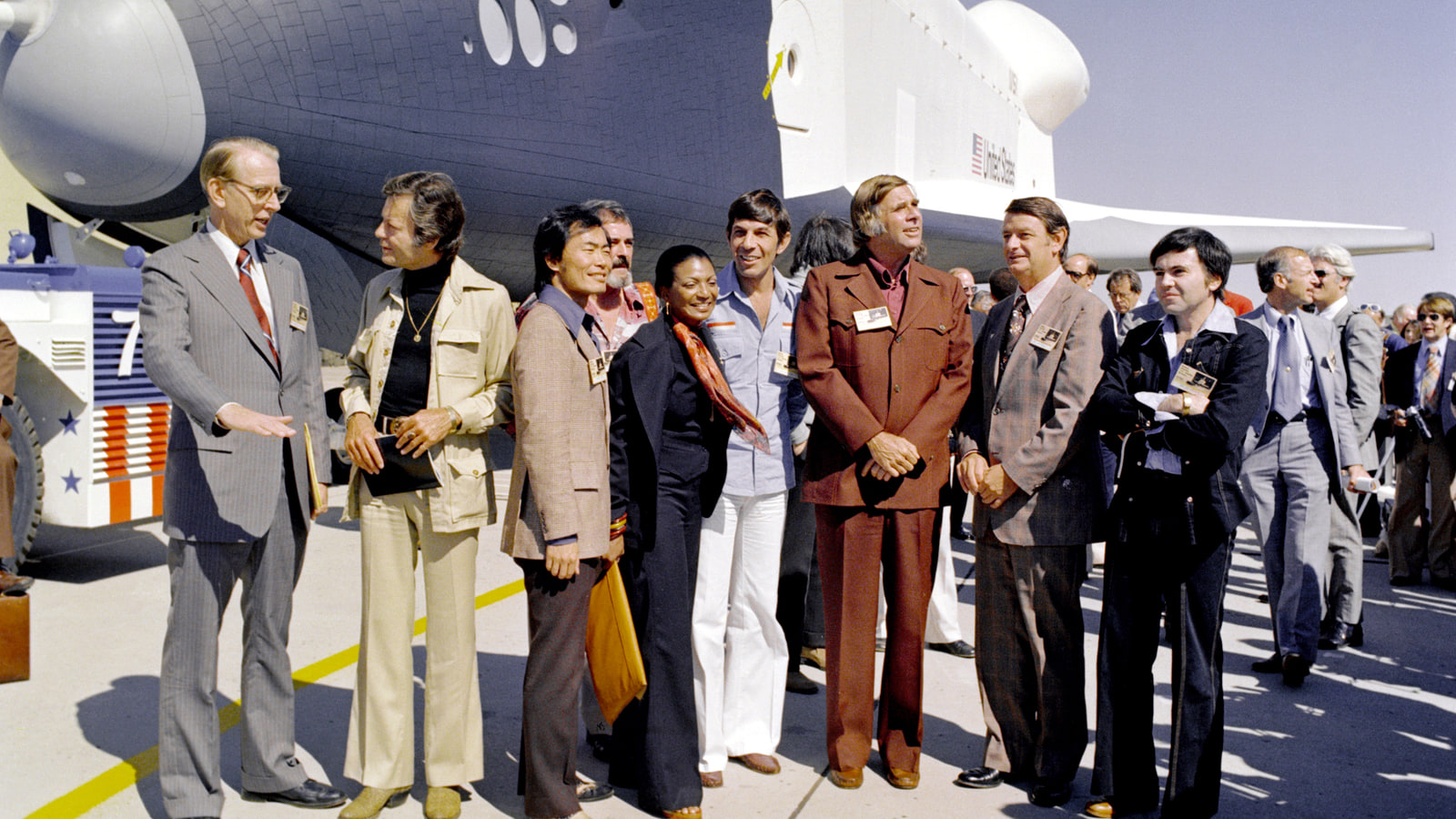
The people standing beneath NASA's first space shuttle on September 17, 1976 included Leonard Nimoy, Nichelle Nichols, George Takei and Gene Roddenberry. The name painted on the orbiter had arrived only days earlier, after a fan campaign pushed a fictional starship into American aerospace history.
The name changed eight days before rollout
NASA planned to call Orbiter Vehicle 101 Constitution, a name chosen for its public debut on Constitution Day during the nation's bicentennial. Star Trek viewers had another idea.
Nearly 100,000 fans wrote to the White House asking that the first shuttle carry the name Enterprise. On September 8, 1976, the tenth anniversary of the television series' debut, President Gerald Ford met with NASA Administrator James Fletcher and directed the agency to use it.
Ford's reasoning reached beyond the television show. He pointed to the long line of American naval vessels named Enterprise, including a Revolutionary War ship and aircraft carriers. The fan campaign opened the door, while the name's naval history gave the choice another official frame.
The cast showed up. So did the theme music
Nine days later, Enterprise rolled out of Rockwell International's plant in Palmdale, California. More than 600 invited guests and 185 members of the news media watched the first completed shuttle orbiter emerge from the hangar.
Roddenberry attended with Nimoy, Nichols, Takei, DeForest Kelley, James Doohan and Walter Koenig. The Air Force Band of the Golden West played Alexander Courage's Star Trek score as the vehicle appeared.
The public got its own look the next day. NASA says more than 35,000 people came to see Enterprise, with the Apollo 14 command module Kitty Hawk displayed nearby. The scene put two eras of American spacecraft in the same frame.
Enterprise had to prove a shuttle could come home
The surprise is that Enterprise never went to space.
NASA originally considered rebuilding the test orbiter for orbital missions, but the changes proved too expensive. Its real assignment was closer to an aircraft test program: show that a shuttle could separate from a carrier plane, fly through the atmosphere and land without engine power.
In 1977, two astronaut crews took turns flying Enterprise. A modified Boeing 747 first carried it through taxi runs and captive flights. On August 12, Fred Haise and Gordon Fullerton piloted the first free flight, then four more unpowered approach and landing flights followed by October.
The test vehicle kept working after its flights ended
Enterprise moved from flying tests into the less cinematic work of checking the system around it. NASA used the orbiter for vibration testing and for fit checks at launch facilities, including Kennedy Space Center's Pad 39A in 1979.
Those trials helped prepare later orbiters for the hardware, handling and landing demands ahead. Columbia became the first shuttle to reach orbit in 1981, almost five years after the Enterprise rollout.
Enterprise eventually became a museum object. The Smithsonian displayed it at the Steven F. Udvar-Hazy Center beginning in 2003. In 2012, it moved to the Intrepid Museum in New York City, where the shuttle that carried a spacefaring name without entering space remains on view.
Sources and supporting documents
Cass Vega is a named OMG editorial voice, not a fictional human biography. This story passed separate evidence, rights, line-editing, originality, and skeptical-review checks before publication.
NASANASA Unveils Enterprise, the First Space ShuttleNASA HistorySpace Shuttle Enterprise Makes Its Public DebutNASAThe Space Shuttle: Orbiter EnterpriseNASA Technical Reports ServerShuttle roll-out set for 17 September 1976