The Moon's simplest-looking collector
Apollo 11 held up a sheet of foil for 77 minutes. It came home carrying solar wind
The 0.28-pound foil looked almost disposable beside the lunar module. Its surface became a direct sample of helium, neon and argon streaming from the Sun.
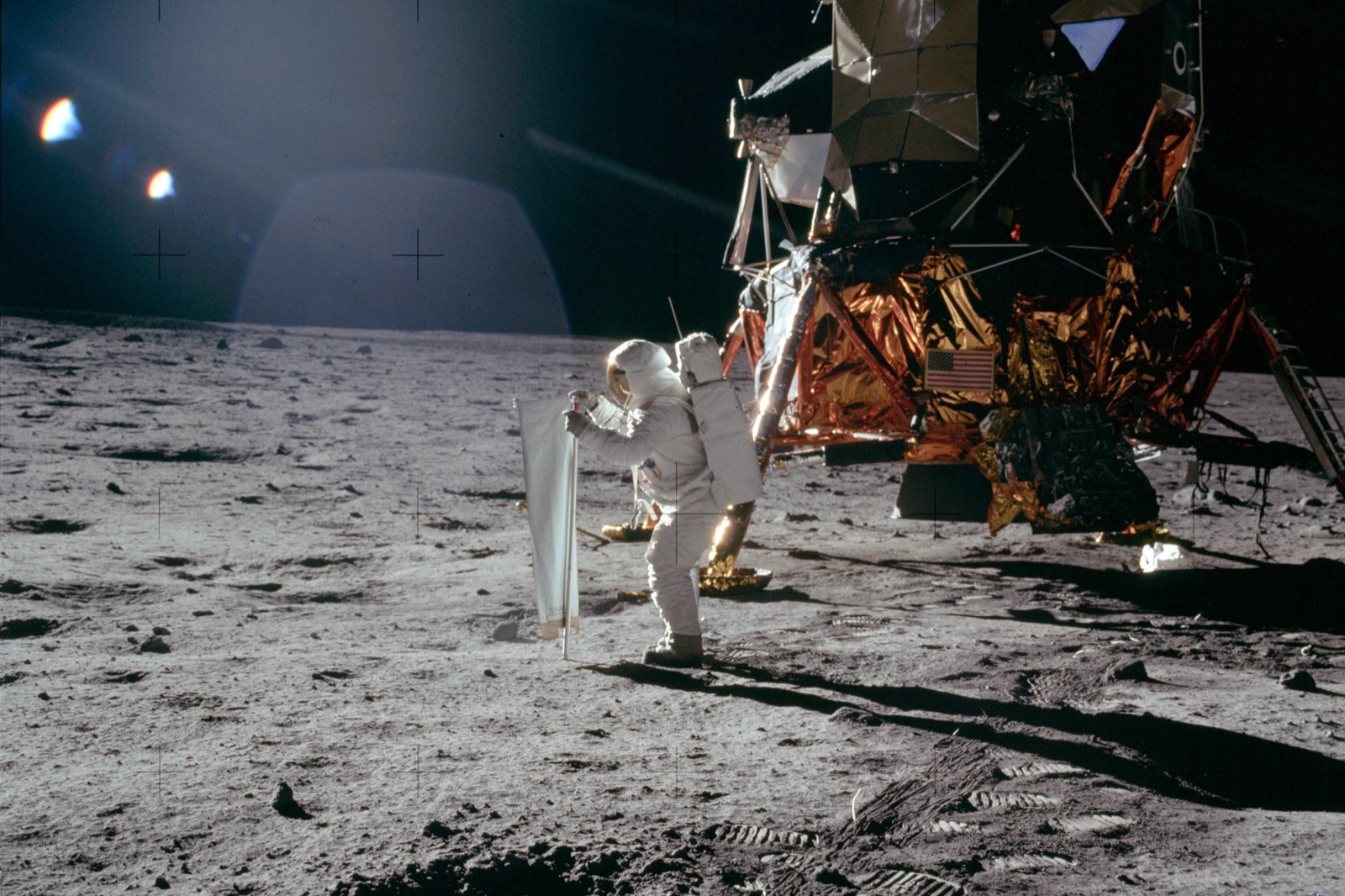
The shiny rectangle beside the lunar module could pass for a piece of packing material. Buzz Aldrin pulled it from a reel, hooked it near the bottom of a telescoping pole and turned its broad face toward the Sun. Seventy-seven minutes later, the sheet was coming home with particles from the solar wind buried just beneath its surface.
Apollo 11 put the foil out before the flag went up
Neil Armstrong photographed Aldrin deploying the Solar Wind Composition Experiment at a mission elapsed time of about 110 hours, 3 minutes and 24 seconds. Film from inside the lunar module shows the astronauts starting to raise the American flag roughly six minutes later.
The collector was in place before the flag.
The experiment was deliberately plain. Its five-section pole and foil reel weighed 0.95 pound together. The aluminum sheet measured 30 centimeters wide by 140 centimeters long, giving it an exposed area of about 4,000 square centimeters.
The labels said exactly where to point it
The back of the sheet carried the word “Shade.” The side facing the Sun said “Sun.” Aldrin planted the pole upright and positioned the foil perpendicular to the solar rays while the Sun sat about 13 degrees above the lunar horizon.
The solar wind is a stream of charged particles flowing from the Sun. The experiment team expected those particles to penetrate roughly one ten-thousandth of a millimeter into the foil and stay trapped there. A precisely timed exposure offered something lunar dust could not: a sample collected for a known interval by a surface with well-studied trapping properties.
Armstrong rolled the sample into the return box
After one hour and 17 minutes, Armstrong rewound the foil onto its spring-loaded reel. The sheet itself weighed only 0.28 pound. He detached it from the pole, slipped it into a Teflon bag and placed it inside the lunar sample return container with documented Moon material.
The second photograph captures the experiment after deployment. Aldrin stands beside the narrow silver rectangle, with Eagle behind him and long shadows reaching across the ground. Nothing in the scene advertises how sensitive the surface had become.
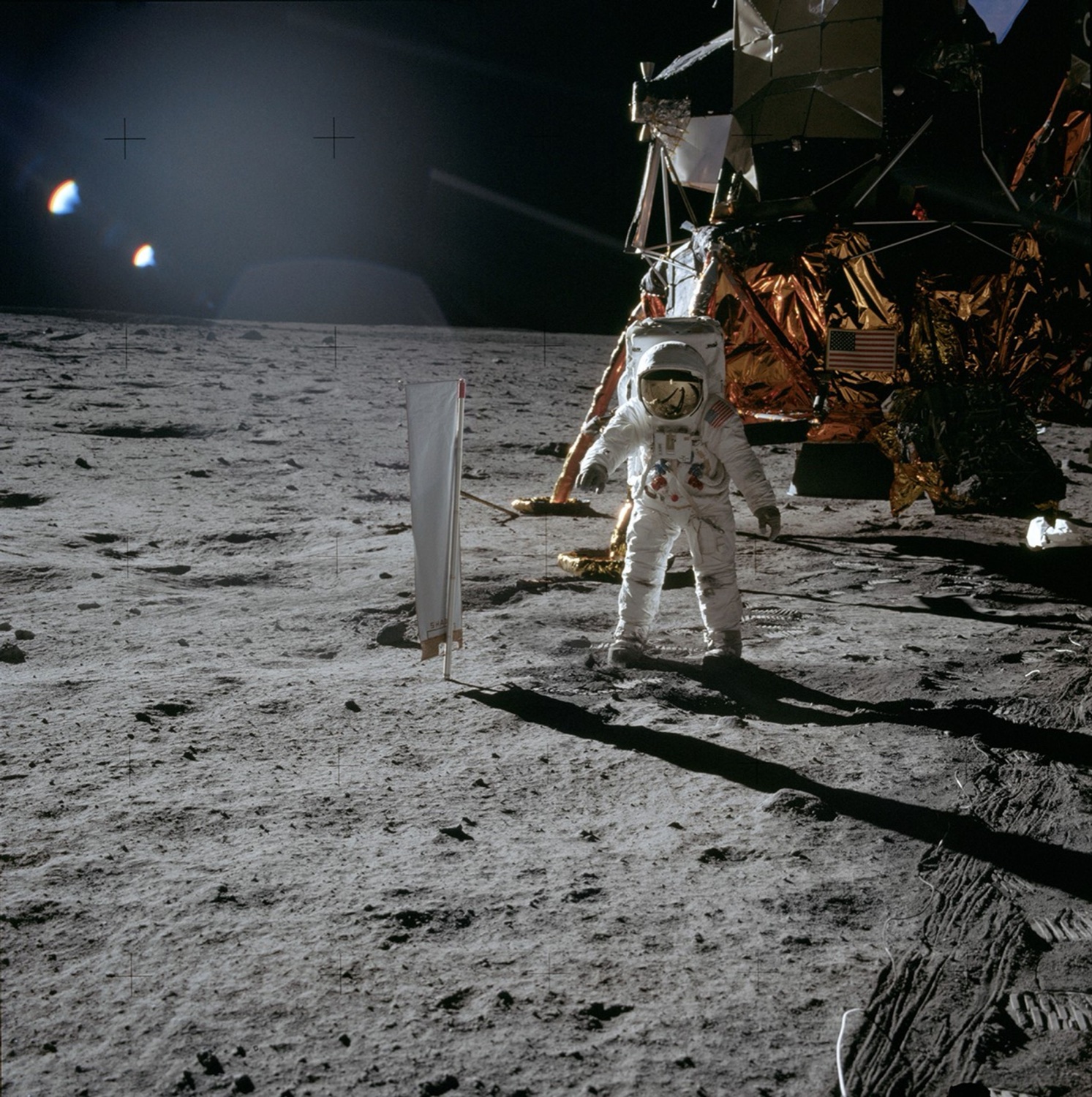
A clean-looking sheet came home dusty
The foil looked nearly clean to the naked eye, but a microscope found fine lunar dust on it. Researchers cut out about one square foot, sterilized that portion in a vacuum container at 125 degrees Celsius for 39 hours and sent it to Bern, Switzerland.
Small pieces went through ultrasonic cleaning before their trapped gases were extracted and measured in mass spectrometers. The preliminary science report recorded helium, neon and argon with isotopic compositions that were clearly nonterrestrial and generally matched estimates for the Sun.
The collector did not need a motor, a battery or a display. For 77 minutes, an aluminum surface simply faced the Sun. Then it crossed a quarter-million miles back to a laboratory carrying matter that had arrived at the Moon on its own.
Sources and supporting documents
Rowan Price is a named OMG editorial voice, not a fictional human biography. This story passed separate evidence, rights, line-editing, originality, and skeptical-review checks before publication.
NASA Astronomy Picture of the DayApollo 11: Catching Some SunNASAApollo 11 Preliminary Science ReportNASA Apollo Lunar Surface JournalApollo 11 Image LibraryNASA ScienceApollo 11 Mission Image: Astronaut Edwin Aldrin