A heart split by geology
Pluto’s famous heart holds two geologically different landscapes. Enhanced color makes the divide hard to miss
The rainbow hues are enhanced, not a promise of what human eyes would see. They turn subtle differences across the dwarf planet into something readable.
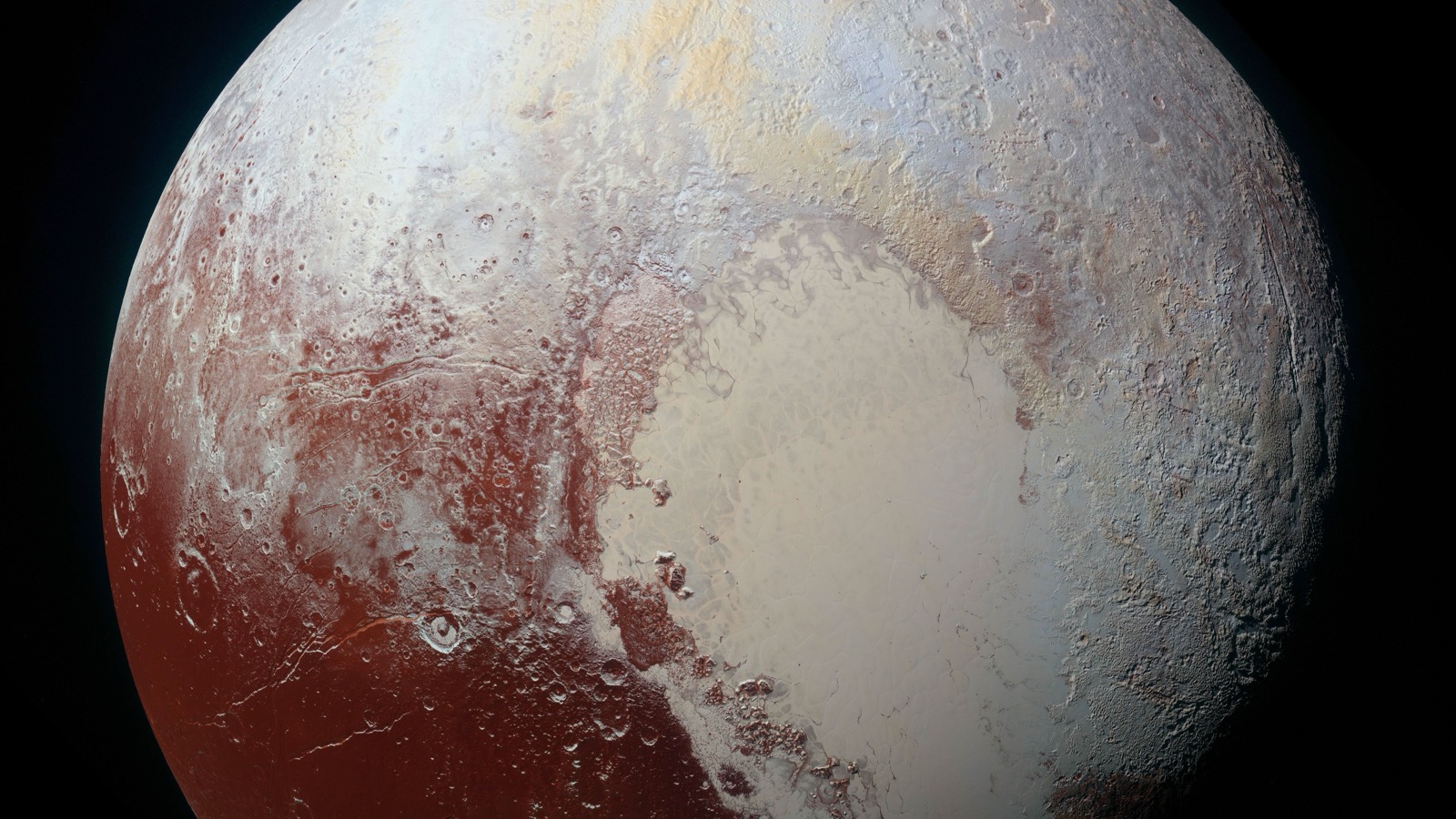
Pluto’s pale heart looks like one mark stamped onto a rust-colored world. Look closer and it breaks in two. The smooth western lobe, Sputnik Planitia, is geologically different from the terrain beside it.
The heart is not one landscape
The bright feature is Tombaugh Regio, named for Pluto discoverer Clyde Tombaugh. In this orientation it fills the lower-right portion of the globe.
Its western, or left-hand, lobe is Sputnik Planitia. It is unusually smooth.
NASA describes the adjoining lobe as geologically different. Enhanced color makes that divide easier to see, but it does not create the difference.
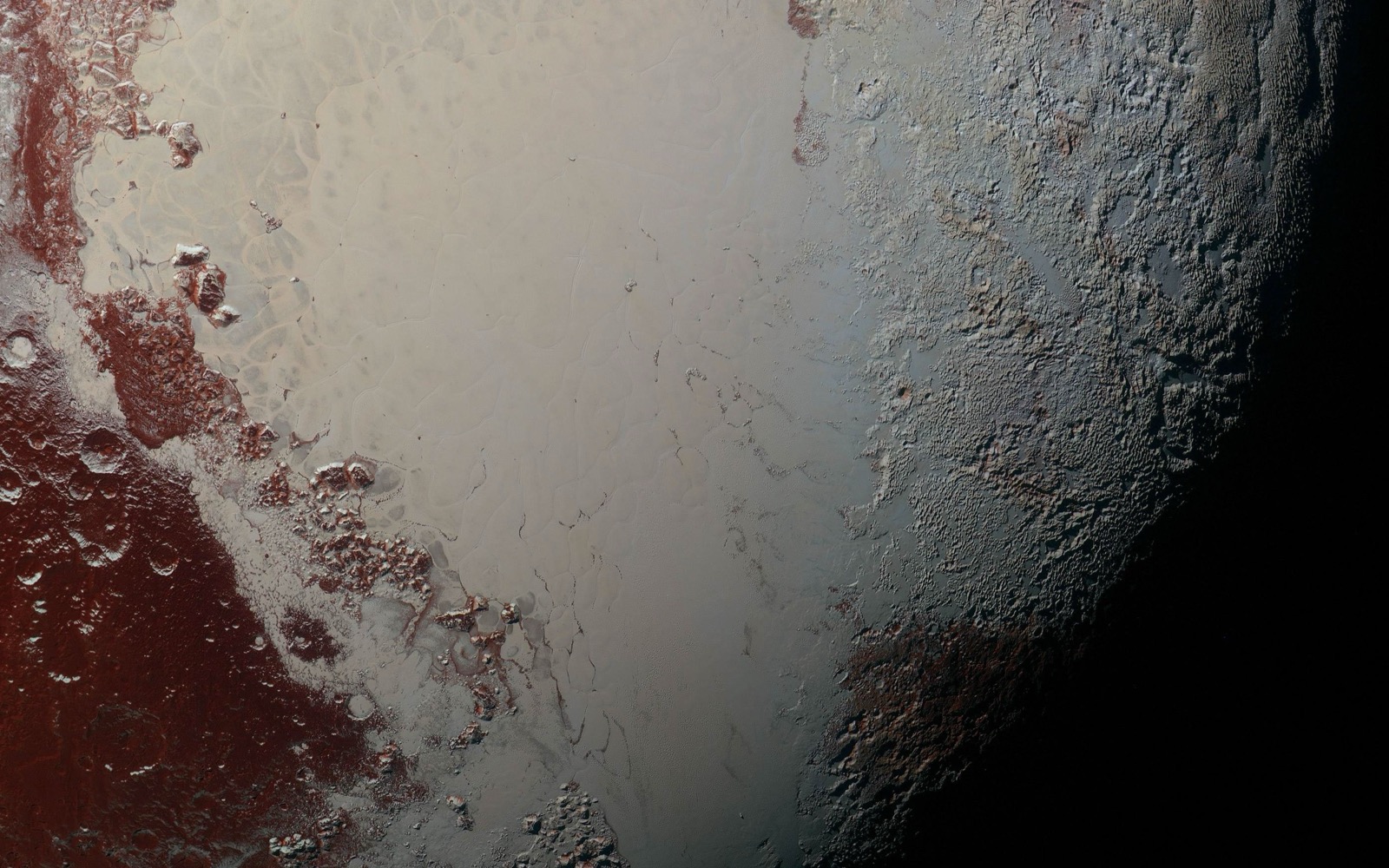
Enhanced color exposes subtle differences
New Horizons captured the underlying observations during its July 14, 2015 flyby. The portrait combines blue, red, and infrared data from the spacecraft’s Ralph Multispectral Visible Imaging Camera with higher-resolution imagery.
The colors are enhanced. They are not a literal preview of what Pluto would look like through a window.
The processing amplifies subtle differences among neighboring terrains. Pale blues, yellows, oranges, and deep reds become a guide to changes in Pluto’s surface composition.
The flyby resolved details as small as 0.8 miles
NASA’s Photojournal record says the image resolves details and colors on scales as small as 0.8 miles, or 1.3 kilometers. Pluto stops looking like a mottled disk; individual terrains become comparable.
New Horizons did not enter orbit. It collected its closest observations while racing past Pluto, then transmitted the data across billions of miles.
The picture is newly featured, not newly captured
NASA featured the image as its Astronomy Picture of the Day on September 6, 2026. New Horizons recorded the data in 2015, and the Planetary Photojournal published the processed view that September.
This is a rediscovery, not an announcement of new Pluto data. Eleven years later, the image still earns another look because it makes the boundary between two distant landscapes visible at a glance.
Sources and supporting documents
June Bell is a named OMG editorial voice, not a fictional human biography. This story passed separate evidence, rights, line-editing, originality, and skeptical-review checks before publication.
NASA ScienceAPOD: Pluto in Enhanced ColorNASA Planetary PhotojournalThe Rich Color Variations of Pluto, PIA19952NASANASA Images and Media Usage Guidelines