A hollow made by stars
Hubble's new N44 portrait holds nearly half a million stars and one enormous hollow
A superbubble roughly 210 by 140 light-years wide dominates this crowded scene in the Large Magellanic Cloud.
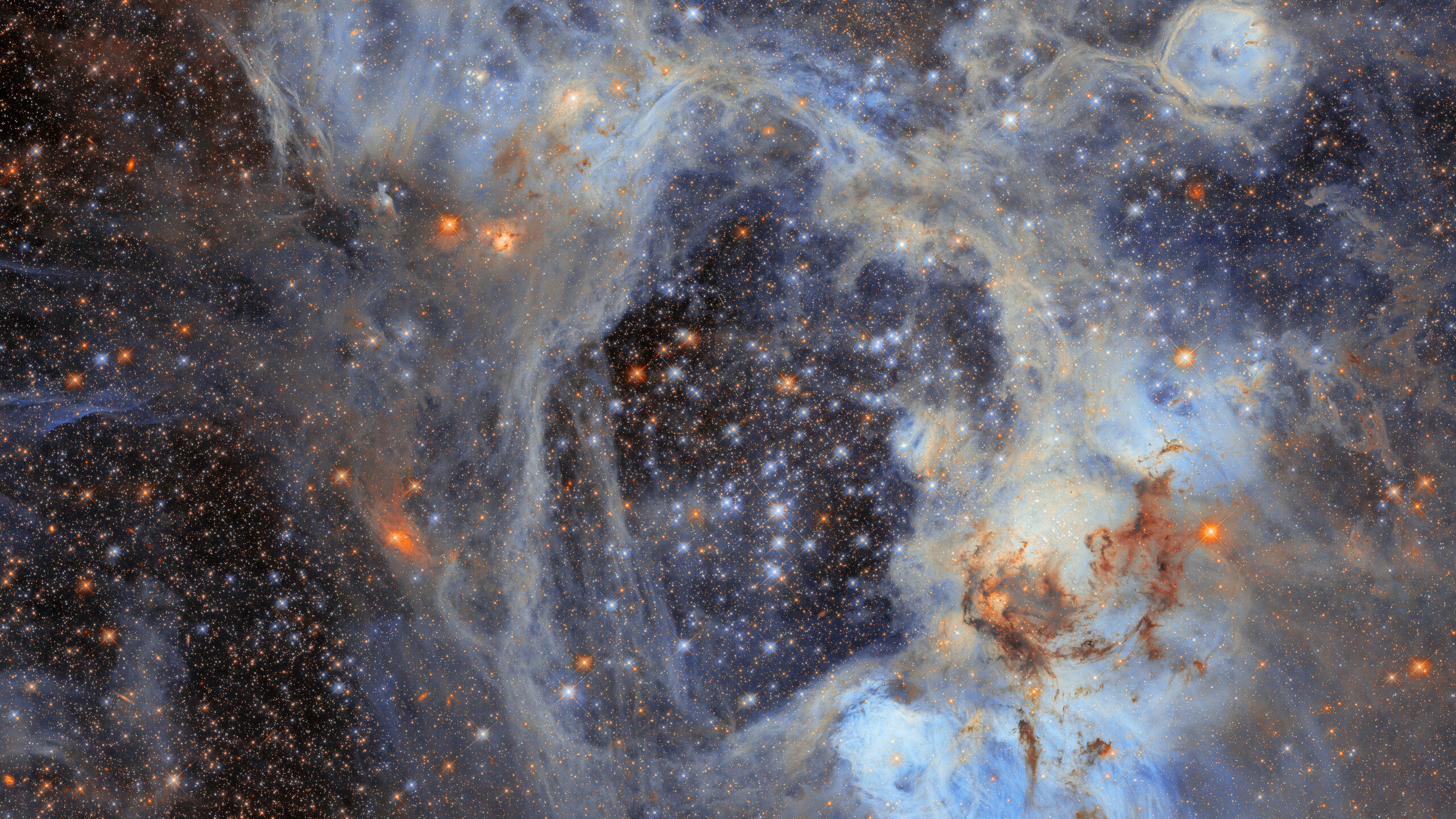
Researchers cataloged nearly half a million stars across this new mosaic, including almost 30,000 that have not begun steady hydrogen fusion. Behind that census lies a hollow 210 by 140 light-years wide, carved by stellar winds and supernovae.
Nearly 30,000 stars in the mosaic have not begun steady fusion
The new mosaic comes from Hubble program 14689, a completed 54-orbit survey led by Dimitrios Gouliermis. Researchers cataloged nearly half a million stars across the field, including foreground objects that only happen to cross the same line of sight.
Nearly 30,000 are pre-main-sequence stars. They have not yet begun the steady hydrogen fusion that defines the main portion of a star's life.
Hubble's sensitivity and sharp resolution allowed astronomers to separate faint objects in a field where stars seem almost stacked on top of one another.
The dark center is evidence of a violent past
N44 sits about 160,000 light-years away in the Large Magellanic Cloud, a small galaxy that orbits the Milky Way. Its most conspicuous feature is an enormous central void called a superbubble.
Stars in the central cluster supplied the force that shaped it. Powerful stellar winds and supernova explosions expelled much of the gas from which those stars formed, leaving the broad, dark-looking cavity visible in the new mosaic.
The hollow is not a clean, empty circle. Stars remain visible across it, while uneven walls of gas and dust trace the region where displaced material accumulated.
The gas piled up around the rim
Material driven out of the center collected in a dense shell around the superbubble. That compression created new sites where gas could gather and stars could begin forming.
Ultraviolet radiation from high-mass stars energizes the surrounding gas and makes parts of the shell glow. Darker lanes mark dust that blocks some of the light behind it.
The mosaic catches the aftermath and the next beginning in the same frame. Older high-mass stars cleared the central cavity; younger stars are forming in gas pressed around its edges.
One corner contains a second bubble with a single star at its heart
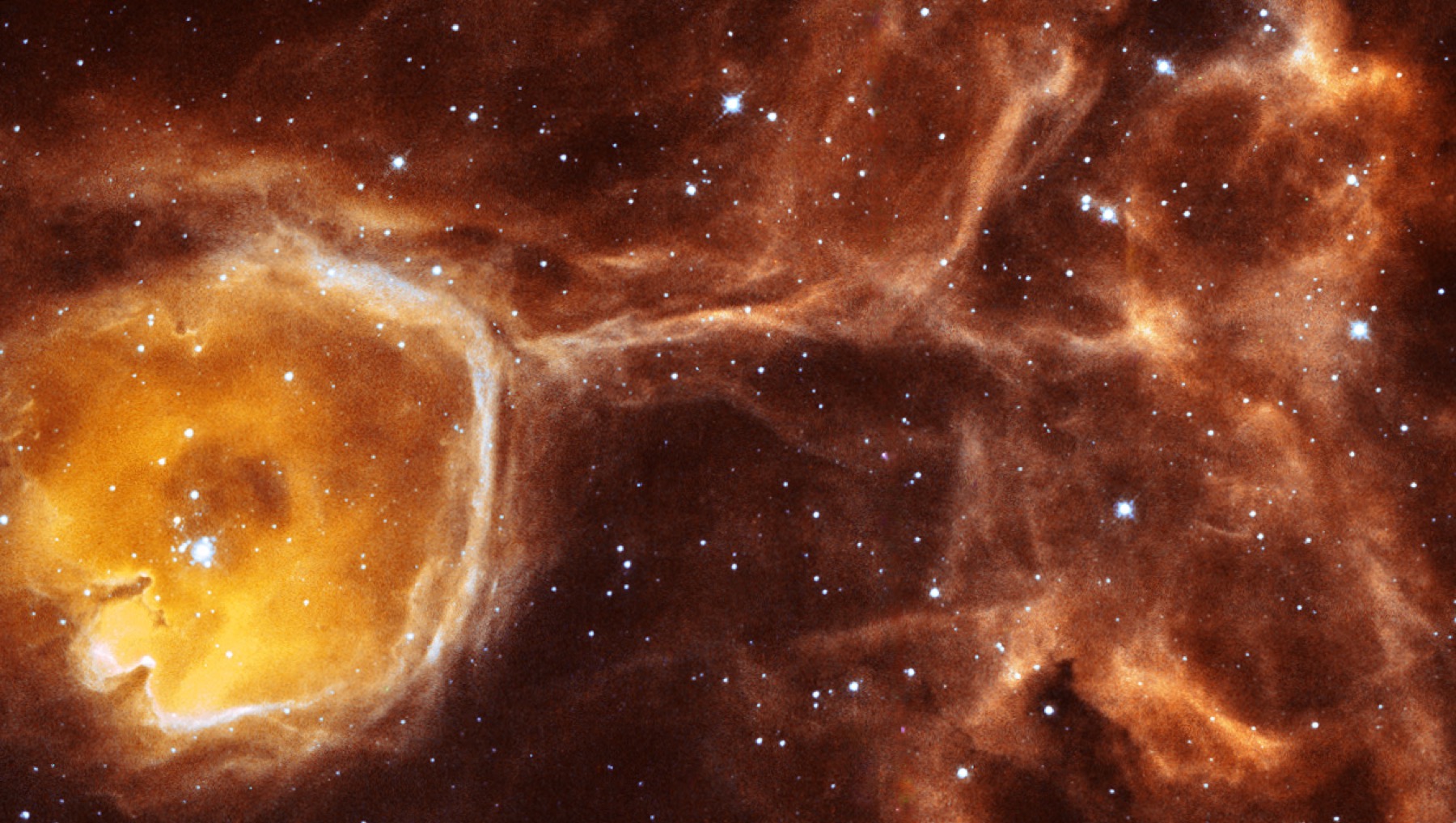
Near the upper-right portion of the larger mosaic sits N44F, a smaller bubble within the same star-forming complex. Its cavity spans roughly 35 light-years.
Unlike the vast central superbubble, which reflects the combined effects of a cluster and multiple stellar explosions, N44F was sculpted by winds and radiation from one hot, high-mass star. The outflow pushed surrounding gas outward and carved finger-like pillars into the bubble's wall.
Astronomers study N44 because the Large Magellanic Cloud contains relatively few elements heavier than helium. Following low-mass stars there can help researchers examine star formation in conditions that resemble more chemically primitive galaxies in the early universe.
Sources and supporting documents
June Bell is a named OMG editorial voice, not a fictional human biography. This story passed separate evidence, rights, line-editing, originality, and skeptical-review checks before publication.
ESA/HubbleA superbubble sceneNASA ScienceNASA's Hubble spies superbubble sceneSpace Telescope Science InstituteHST Program 14689: Mapping Young Stars in Space and TimeESA/HubbleHubble peers inside a celestial geode