Planetary weather
Saturn already had a hexagon. Now astronomers have found a decagon at the other pole
Amateur astronomers noticed the first hints from Earth. Hubble then showed that the shape reaches through more than one layer of Saturn's atmosphere.
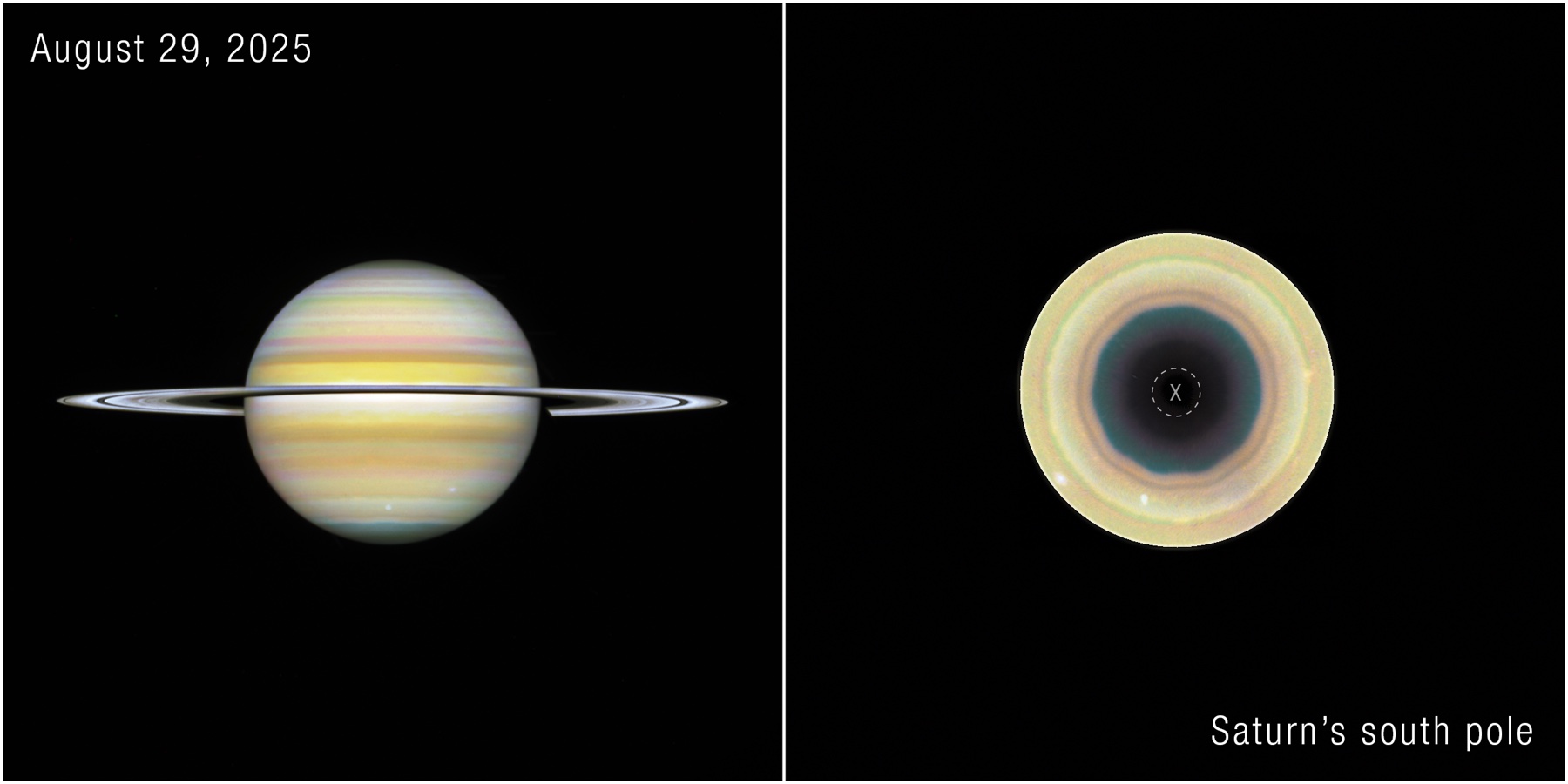
A faint kink in Saturn's southern clouds kept sharpening. Across Hubble images from 2023, 2024 and 2025, researchers watched it resolve into a ten-sided wave around the pole.
The shape went from a hint to a pattern
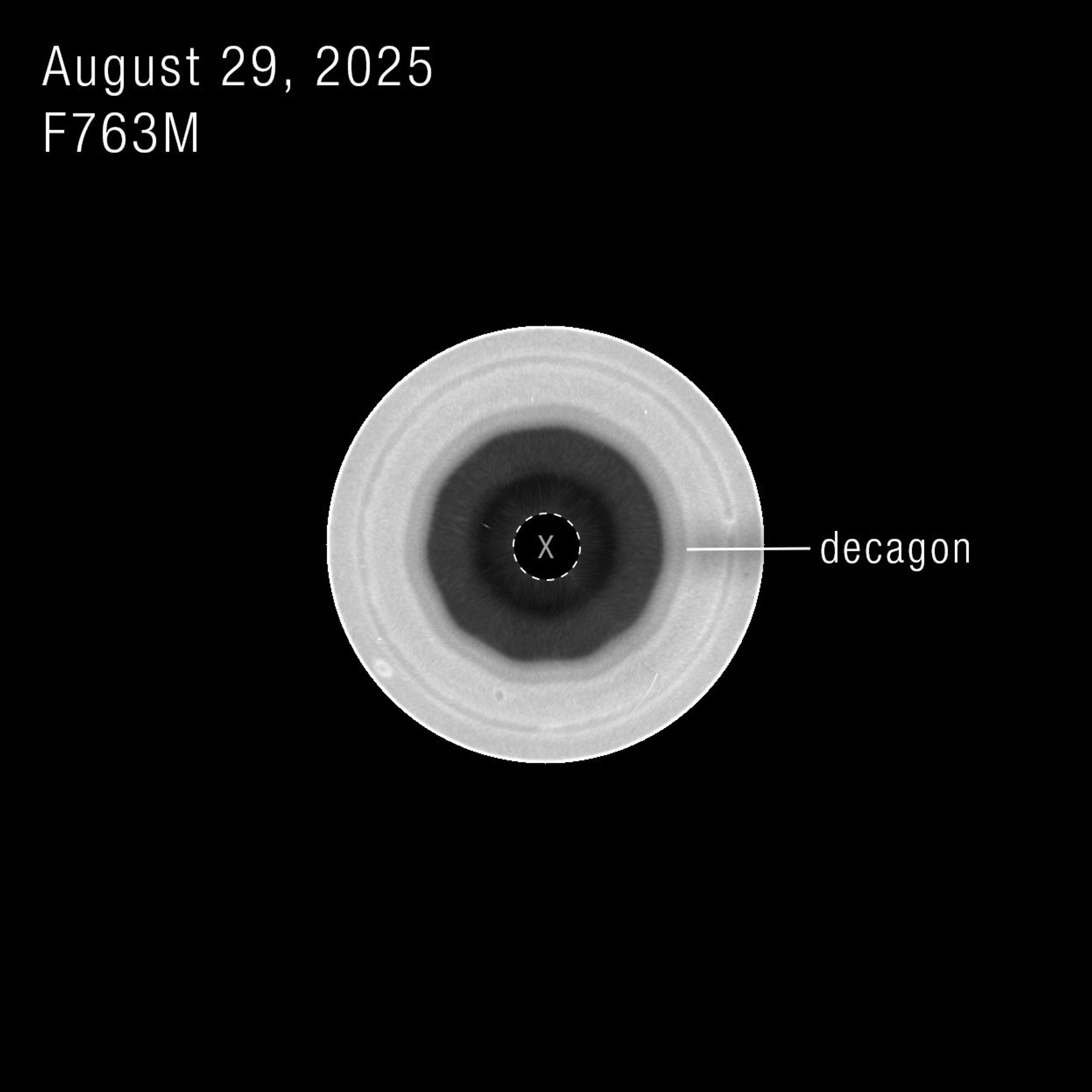
In the 2023 observations, researchers could trace only weak corners and straighter stretches. By 2025, the outline had sharpened enough to count all ten sides around the southern polar region.
A pattern that survives separate observing seasons is harder to dismiss as a quirk in one image.
The paper describing the wave appeared September 2 in Science Advances. The team does not yet know whether the shape is settling in for decades or passing through a shorter phase.
Ground-based observers caught the first wobble
The first clues did not come from Hubble alone. Amateur astronomers Trevor Barry and Jean-Paul Oger noticed an uneven band near the south pole in ground-based images beginning in 2024. Additional observations in 2025 made the possibility harder to dismiss.
Hubble supplied the sharper view. Its images can follow Saturn through a full rotation without the blur introduced by Earth's atmosphere, allowing the researchers to test what the ground-based network had spotted.
This is weather, not a solid outline
The decagon moves east at about 2.5 meters per second, a crawl beside the jet stream racing past at about 116 meters per second. Its corners wobble with a period of roughly 32 days.
Observations at different wavelengths place the wave through multiple levels of the atmosphere rather than on a single cloud deck.
Its apparent position shifts slightly from one wavelength to another because each filter reaches a different altitude. The corners are the visible signature of motion in gas, not ten rigid walls standing over the pole.
The next question is whether it stays
Saturn's northern hexagon has appeared whenever astronomers have looked for more than forty years. No comparable southern polygon appeared in earlier Hubble searches or in images from the Cassini mission, which orbited Saturn from 2004 through 2017.
Researchers plan to keep watching with Hubble and the James Webb Space Telescope while they test atmospheric models against new observations. Future observations should show whether Saturn's second polygon is fading or settling in.
Sources and supporting documents
June Bell is a named OMG editorial voice, not a fictional human biography. This story passed separate evidence, rights, line-editing, originality, and skeptical-review checks before publication.
NASA ScienceNASA's Hubble tracks new decagon encircling Saturn's south poleScience AdvancesA decagon wave around Saturn's south pole