An immovable room gets a passport
The Peacock Room must stay inside its museum. Its VR double is being built to travel
The Smithsonian's first VR experience will reconstruct the room in its London, Detroit and Washington settings. It premieres February 12, 2027.
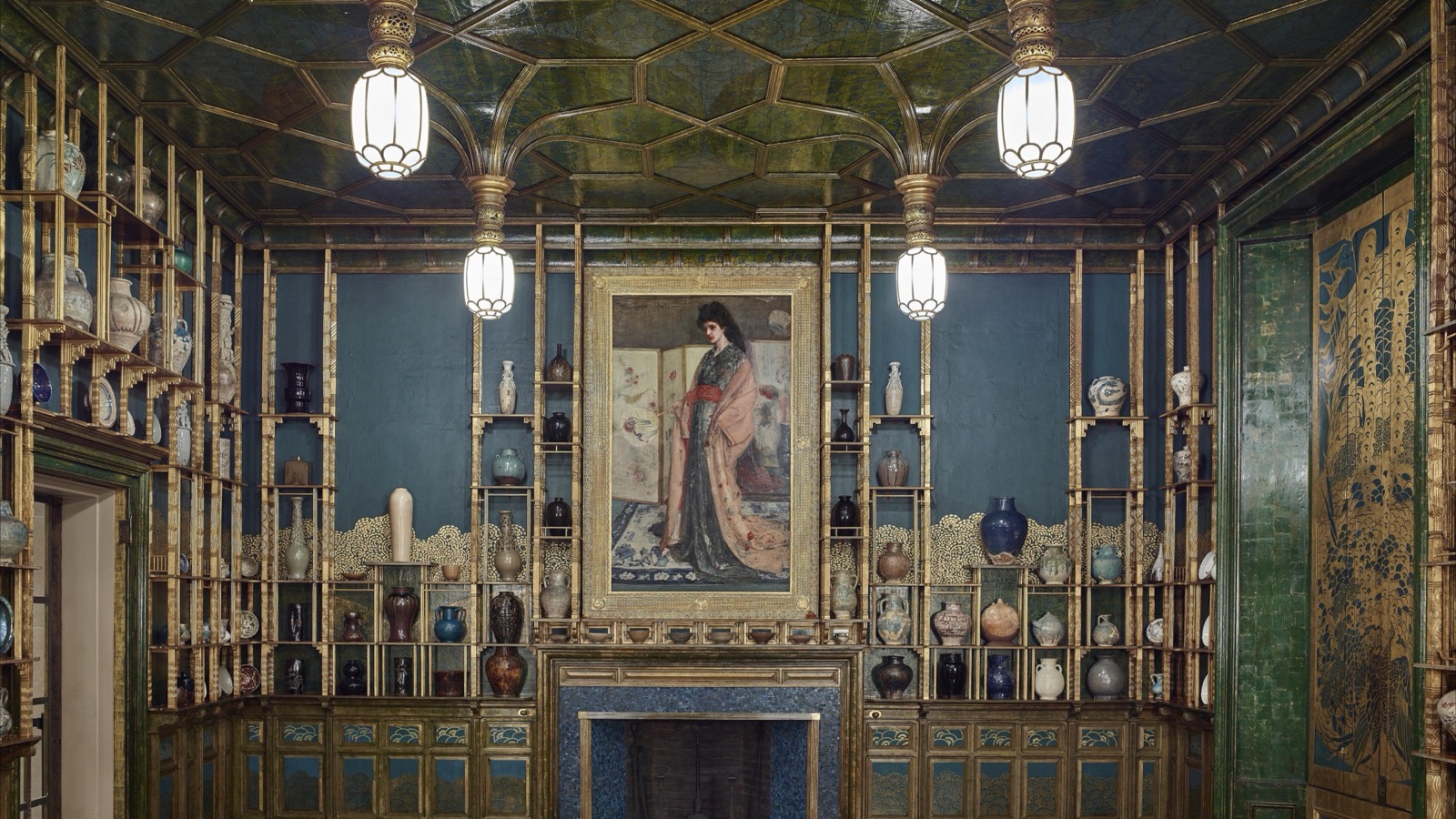
At the Smithsonian's National Museum of Asian Art, one room stretches nearly 34 feet from end to end. Gold leaf catches between blue-green patterns. Ceramics fill a grid of narrow shelves. James McNeill Whistler's painting The Princess from the Land of Porcelain holds the center above the fireplace. The room has crossed an ocean and lived at three addresses. Now the terms of museum founder Charles Lang Freer's bequest require the original collection, including the Peacock Room, to remain inside the museum. That makes an ordinary loan impossible. The museum's answer is a digital reconstruction designed to go where the original cannot. A Gorgeous Surprise: The Peacock Room in VR is scheduled to premiere February 12, 2027. The long-term installation will be the museum's first virtual reality experience and will mark the room's 150th anniversary.
A dining room that became a painting
The Peacock Room began as the dining room of British shipowner Frederick Leyland's London home. Architect Thomas Jeckyll built an intricate framework of shelves for Leyland's Chinese porcelain and hung gilt leather on the walls.
Jeckyll became ill before the room was finished. Whistler, who was working elsewhere in the house, offered to complete it. He did much more.
Whistler treated the entire interior as a three-dimensional painting. Blue, green and gold spread across the woodwork, shutters and ceiling. Peacock feathers became a visual rhythm. His butterfly signature appeared more than once.
His expanding revisions and a dispute over payment provoked a bitter quarrel with Leyland. The conflict eventually found its way onto the wall. In the mural now known as Art and Money: or, The Story of the Room, two peacocks represent the artist and patron in combat.
That clash is part of the planned VR narrative. The museum says an audio layer will tell the story of the quarrel, the room's move to America and its three different homes.
Three addresses inside one headset
The room's first life unfolded in London. Freer bought it in 1904 and installed it in a purpose-built space in his Detroit home in 1906, where he replaced Leyland's porcelain with ceramics from his own collection.
Its third home was Washington. The room was installed in the Freer Gallery of Art and has been open to the public since the museum opened in 1923.
The VR project is being built around those three settings. The museum says visitors will be able to explore the architecture, wall designs and ceramics at close range. An animated version of the woman in The Princess from the Land of Porcelain is planned to move beyond the frame.
That last feature may be the clearest break from a conventional virtual museum tour. This is not being presented simply as a scan that lets viewers turn their heads. The announced experience combines 3D capture, animation, voiceovers and historical reconstruction.
The rule that keeps the room home
Museums routinely lend paintings, sculptures and other objects. The Peacock Room belongs to a collection governed by a stricter rule.
Freer's bequest requires the original collection to remain inside the museum. The rule settles the question before logistics enter it: the physical Peacock Room cannot become a traveling loan.
A digital version changes the problem. The museum says it will announce opportunities to experience the VR project at international partner institutions later in 2027. It also plans to make the full experience available online eventually.
Neither the partner locations nor an online release date has been announced. The physical Peacock Room is not beginning a tour. A digital reconstruction is being designed to travel while the original remains in Gallery 12.
What opens in February
The VR experience will open alongside the Washington debut of a major James McNeill Whistler retrospective after presentations at Tate Britain in London and the Van Gogh Museum in Amsterdam. The museum describes Washington as the exhibition's only United States stop.
The VR project remains a preview rather than a finished experience the public can judge. The details available now come from the museum's announcement; visitors have not yet had access to test its promised immersion or emotional effect.
The project exists because the room has survived intact and the bequest keeps it in place. That protects the original while limiting where people can encounter it in person.
The physical room is staying in Washington. The part being prepared for another journey is made from scans, sound and animation.
Sources and supporting documents
Rowan Price is a named OMG editorial voice, not a fictional human biography. This story passed separate evidence, rights, line-editing, originality, and skeptical-review checks before publication.
Smithsonian's National Museum of Asian ArtVirtual Reality Experience Brings Iconic Peacock Room to Life at Smithsonian's National Museum of Asian ArtSmithsonian InstitutionHarmony in Blue and Gold: The Peacock RoomSmithsonian's National Museum of Asian ArtThe Room TravelsSmithsonian InstitutionSmithsonian Open Access FAQ