One galaxy, two directions
This spiral galaxy's center rotates at a right angle to the rest
The new image shows the unusual structure whose hidden motion astronomers uncovered with spectroscopy.
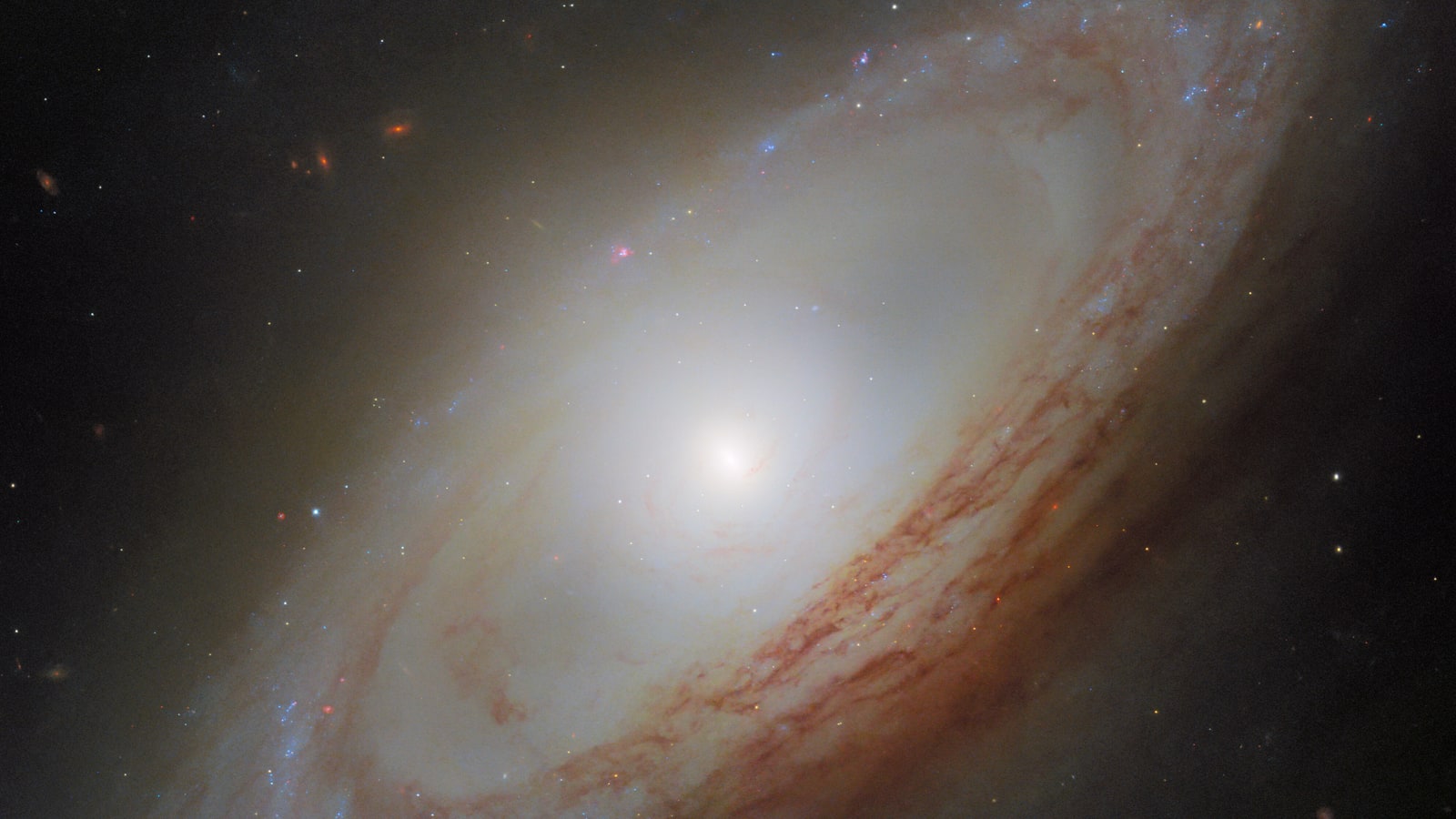
You cannot watch a galaxy rotate in a still photograph. Hubble's new portrait of NGC 4698 shows the odd structure astronomers had already investigated: a pale central bulge sticks above and below a dusty spiral disk, as if one galaxy had been threaded through another at a right angle.
The spiral arms stop short of the center
The pattern breaks before the spiral reaches the middle. Its arms become most obvious near the outer edge, where they form something closer to a ring instead of curling all the way inward. The glowing bulge at the center stretches in another direction, faintly peeking above and below the plane of the disk.
At first glance, NGC 4698 still has the familiar ingredients of a spiral. Brown dust lanes cross its disk. Blue stars dot the arms. A bright concentration of older, cooler stars fills the middle.
The galaxy sits about 55 million light-years away in the constellation Virgo. It belongs to the Virgo Cluster, a gathering of more than 1,000 galaxies bound together by gravity.
The sideways motion came from spectra, not the picture
That odd shape is visible. The rotation is not.
Astronomers established the motion by measuring how starlight shifts along different parts of the galaxy. Observations published in 1999 found a velocity pattern that did not fit a single disk turning around one axis. The bulge and the main disk appeared to have angular momenta pointing in perpendicular directions.
Later work sharpened the picture. A 2012 study described a small central disk of stars and gas rotating perpendicular to the galaxy's main disk. The authors also found that the larger bulge itself is elongated across the plane of the galaxy rather than lying neatly inside it.
The new image adds detail to an arrangement that spectroscopy and earlier imaging had already exposed.
One explanation begins with gas from outside
A tidy spiral would be difficult to build this way in one uninterrupted step. The competing axes suggest that NGC 4698 went through at least one additional event after part of the galaxy was already in place.
One proposed explanation starts with material falling in from outside. Gas arriving at an angle could settle into a central disk on a different plane, then form stars there. The 2012 analysis found that this external-gas scenario fits the structure of the nuclear disk, while making clear that the galaxy's history cannot be replayed from a single image.
There is another clue. Astronomers have detected a short tail of hydrogen extending from one side of NGC 4698. That feature is consistent with a past minor merger, but it is not a timestamp or a complete reconstruction. The crossed axes and hydrogen tail point to a disrupted past, but neither reveals exactly when or how it happened.
Hubble is looking beyond the postcard
The portrait comes from Hubble observing program 18103, led by astronomer David Thilker and the MAUVE-HST Team. It uses ultraviolet and visible light to resolve star clusters and glowing nebulae inside Virgo Cluster galaxies, while examining how a crowded environment changes their evolution and ability to make stars.
NGC 4698 turns that broad survey into one disorienting image. The dusty outer disk runs one way. Its luminous center points another. Only the measurements reveal that the split is not just visual. Deep inside the frame, two parts of the same galaxy are keeping time around different axes.
Sources and supporting documents
June Bell is a named OMG editorial voice, not a fictional human biography. This story passed separate evidence, rights, line-editing, originality, and skeptical-review checks before publication.
ESA/HubbleA galaxy spinning out of syncNASA ScienceNASA's Hubble Spots an Out-of-Sync GalaxyThe Astrophysical Journal Letters via arXivThe Bulge-Disk Orthogonal Decoupling in Galaxies: NGC 4698Monthly Notices of the Royal Astronomical Society via arXivPolar bulges and polar nuclear discs: the case of NGC 4698ESA/HubbleUsage of ESA/Hubble Images and Videos