Three lights, one horizon
An astronaut photographed purple aurora from 255 miles up. Its color is a clue
Green oxygen light gives way to purple above Earth's curve in a new astronaut photograph taken over Kyrgyzstan.
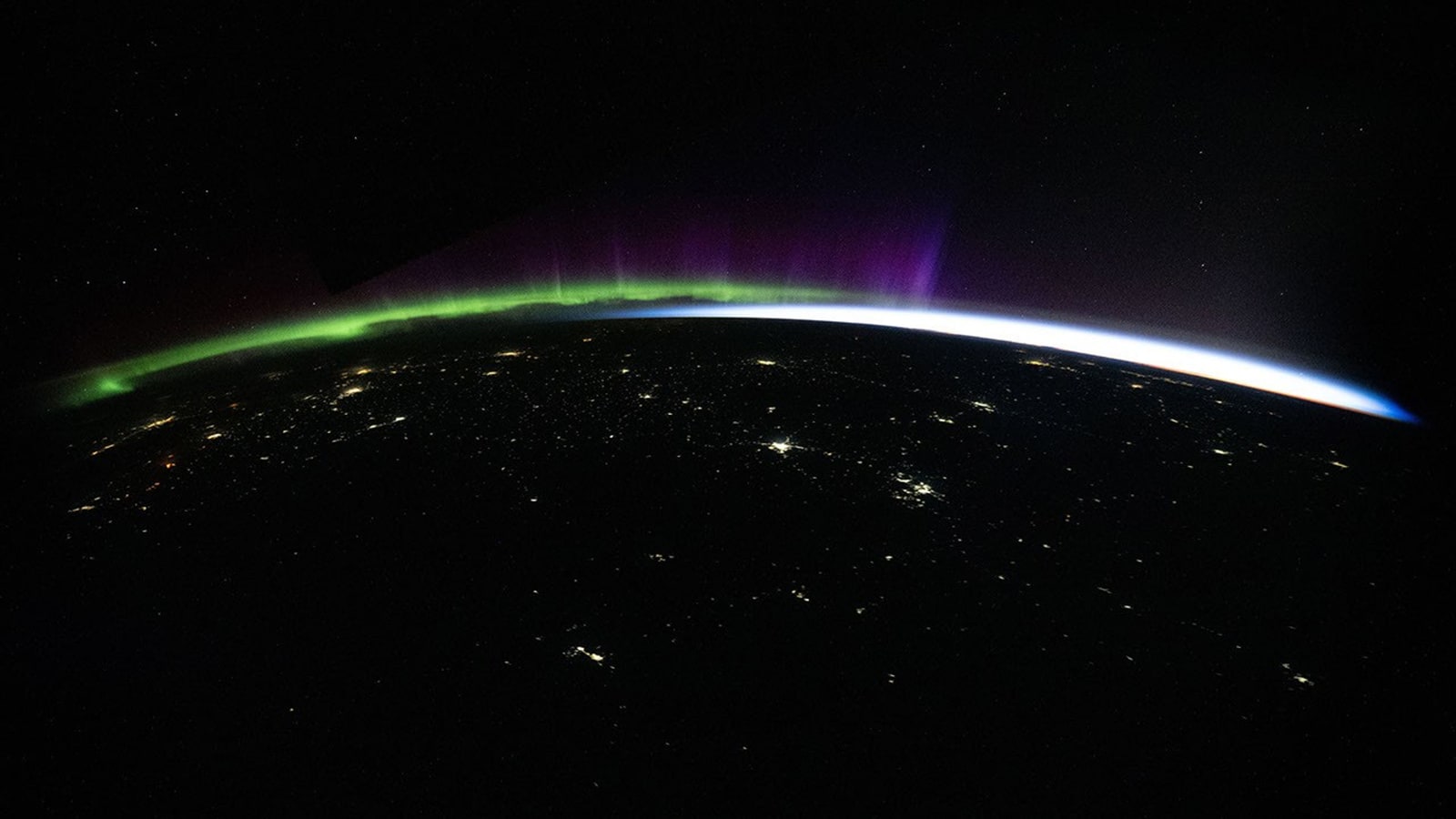
From 255 miles above Kyrgyzstan, an astronaut pointed a Nikon Z9 at Earth's night side. The frame catches three kinds of light along one curved horizon: cities below, a thin white atmospheric arc and aurora climbing from green into purple.
The frame has a time, place and camera
The photograph, cataloged as ISS075-E-88592, was taken from the International Space Station on September 7 and published by NASA Earth Observatory on September 16. The station was 255 miles, or 411 kilometers, above Kyrgyzstan when the shutter opened.
NASA says an Expedition 75 crew member used a Nikon Z9 with a 15-millimeter focal length. The agency cropped the image, increased its contrast and removed lens artifacts before release.
Those details matter. The picture is a processed observation from a specific night, not a live view or a forecast for what someone on the ground will see next.
Green and purple come from different collisions
Aurora begins when energy from the solar wind enters Earth's magnetosphere and accelerates particles toward the upper atmosphere. Collisions give oxygen and nitrogen extra energy. When those atoms and molecules release it, they emit light.
NASA places the familiar green oxygen glow roughly 60 to 120 miles above the surface. Oxygen can glow red higher up. Excited nitrogen in a similar altitude range can emit blue or pink, and the colors can overlap until the camera records purple, pink or even white.
The purple is not decorative color added to the scene. It is light from the atmosphere, but a single photograph cannot separate every emission or assign each visible patch to one gas with laboratory precision.
A minor storm made a major-looking photograph
The storm behind the frame was officially minor.
NASA linked the display to a high-speed stream of solar wind from a coronal hole, along with lingering effects from multiple coronal mass ejections. NOAA classified the associated geomagnetic activity at the G1 level, which the agency labels minor.
That label describes the storm scale, not the visual size of the aurora in a wide-angle image. A lower storm category can still produce an enormous curtain when the camera is looking across hundreds of miles of atmosphere from orbit.
The disturbance was active on September 7. It should not be read as a current warning or a promise of aurora over the same places now.
The white edge is a different glow
The layers only look close.
The bright white arc hugging Earth's limb is airglow, a faint emission that exists across the upper atmosphere even when an aurora is not blazing. From the station's sideways view, airglow, aurora and city lights appear stacked on the same curved boundary.
Cameras can also register dim color that human night vision struggles to separate. NOAA notes that digital sensors may detect aurora and its colors when the display is too faint for the eye.
That leaves the most useful way to read the frame: three sources of light, three different processes and one unusually clear line of sight across the edge of the planet.
Sources and supporting documents
Rowan Price is a named OMG editorial voice, not a fictional human biography. This story passed separate evidence, rights, line-editing, originality, and skeptical-review checks before publication.
NASA Earth ObservatoryPurple Haze AuroraNASA ScienceAurorasNOAA Space Weather Prediction CenterAurora Tutorial