What happened before the fish vanished
Virtual fish vanished. A glassfish withdrew only after they had swum like its own species
Smoothly moving models did not produce the same response, and the withdrawal differed from the faster escape caused by a directly looming threat.
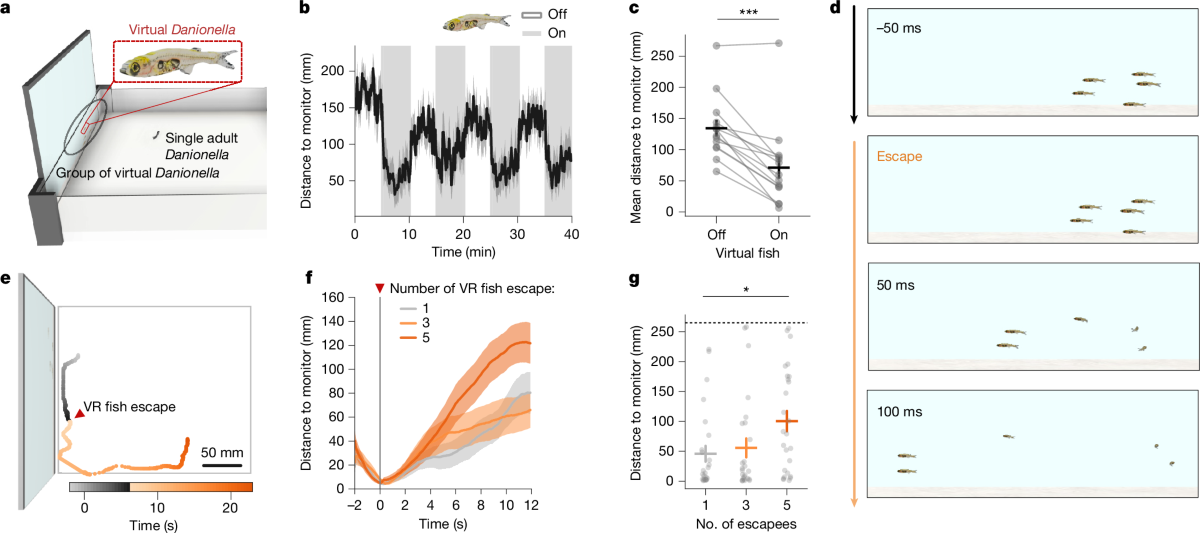
One 12-millimeter observer approached a school of five animated shapes crossing a monitor. When it came within 16 millimeters of the group, the program presented one of three outcomes: keep swimming, dart away or vanish. The observer pulled away after both escape and disappearance, but only when the models had first moved with the burst-and-glide rhythm recorded from its kind. When the same shapes traveled smoothly, the animal's distance from the monitor barely differed across the three outcomes. What happened at the end mattered only after the school had moved like a school.
A school on a screen had to look alive
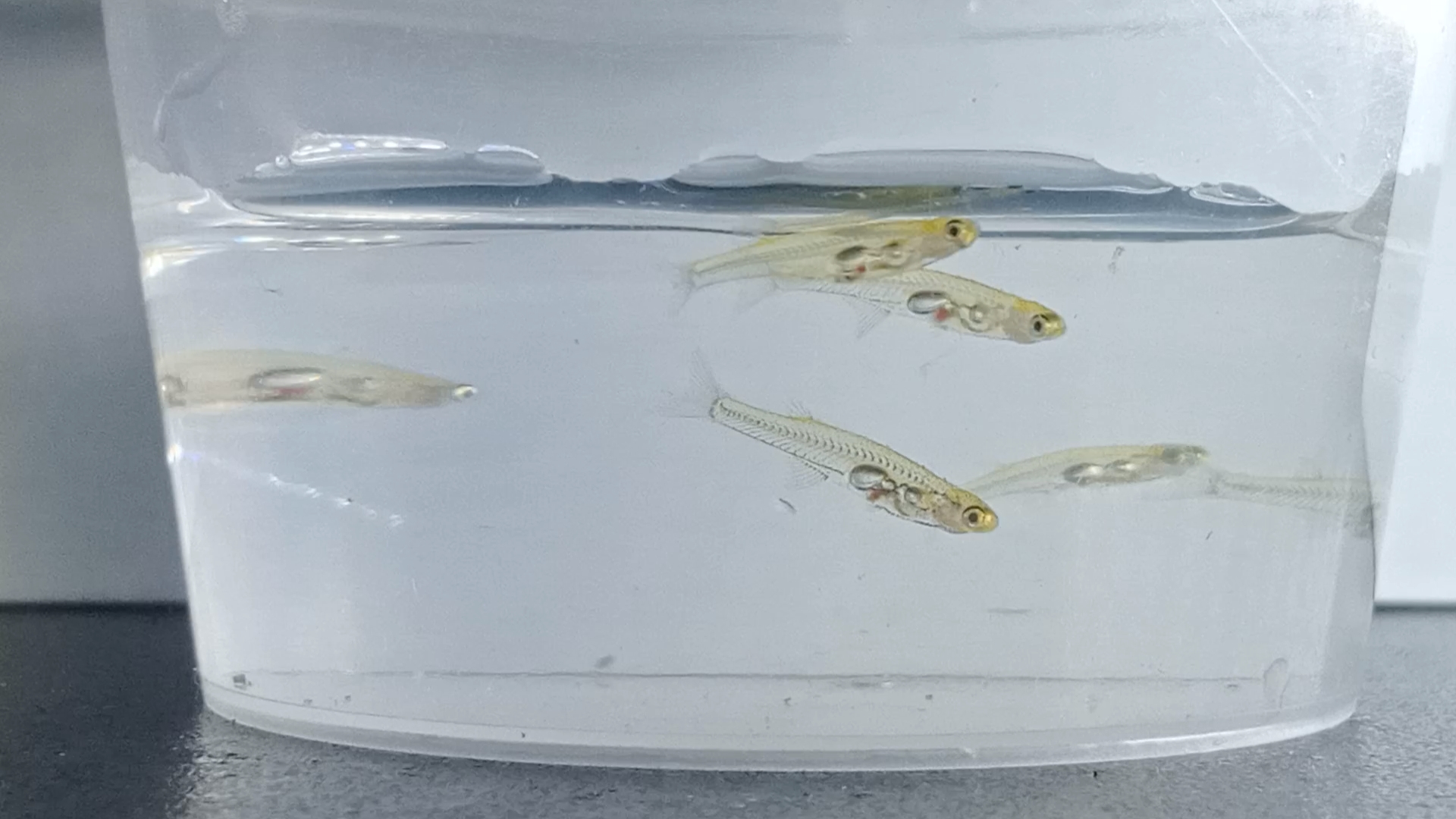
Danionella cerebrum is a translucent schooling fish about 12 millimeters long, small enough for scientists to record activity across much of its brain. For the freely swimming behavioral tests, researchers placed one real fish in an arena beside a monitor and rendered five virtual males. Each model also appeared about 12 millimeters long on the screen.
The display drew the animals closer. In an earlier engagement test with 14 fish, they stayed an average of 71.1 millimeters from the monitor while the virtual school was visible, compared with 134.4 millimeters during blank baseline periods.
The researchers then changed how the virtual fish moved. One school used burst-and-glide motion derived from real glassfish, with animated tails during each burst. The other traveled smoothly at the average speed of that swimming cycle and had no animated tail beat. The fish shapes remained. Their characteristic rhythm did not.
The difference appeared after the 16-millimeter trigger
Once the real fish crossed the 16-millimeter threshold, the virtual school either continued normally, escaped or disappeared. Researchers measured the observer's average distance from the monitor five to twelve seconds later.
After burst-and-glide motion, the distances separated sharply: 40.4 millimeters when the school continued across 39 sessions, 84.1 millimeters after escape across 39 sessions and 69.8 millimeters after disappearance across 41 sessions. The responses to escape and disappearance were not significantly different from each other.
The smooth-motion control produced a different pattern. Across 35 continue, 36 escape and 34 disappearance sessions, the corresponding distances were 66.0, 65.6 and 61.8 millimeters. The three outcomes did not produce the behavioral split seen after species-typical movement.
The paper describes the response as withdrawal or disengagement from the virtual school. It was not the faster escape caused by a directly looming object, and no predator appeared in this test. The experiment therefore does not show that the fish interpreted disappearance as proof of a predator. It shows that an observer pulled away when a socially plausible mover either fled or vanished.
Two imaging phases answered different questions
The researchers next used two-photon calcium imaging while glassfish watched controlled visual displays. In the first imaging phase, they classified 23,452 stimulus-responsive neurons from 12 adult fish. Biological motion produced stronger activity than smooth linear motion, and biological motion followed by escape produced a stronger response than routine swimming.
A separate experiment used realistic virtual fish that moved with either burst-and-glide or linear motion before escaping, disappearing or remaining visible. The classifier results came from 15 imaging sessions with at least eight trials of each type.
Before the final action, neural activity distinguished biological from linear movement with 72.6 percent accuracy. After the action, the classifier distinguished escape from disappearance with only 50.2 percent accuracy, which the researchers considered ineffective.
Cells that responded when biologically moving fish escaped also responded when those fish disappeared. The same response was weaker when smoothly moving models vanished. Responsive neurons appeared across the recorded brain regions, including important populations in the optic tectum and thalamus. The experiment does not establish whether that computation begins with retinal input or emerges later in midbrain and thalamic circuits.
A fish response, not a rule for people
The authors suggest that this sensitivity may suit a fish found in turbid water, where a fast-moving neighbor can quickly leave the visible range. That remains an ecological interpretation of laboratory work conducted with screens and controlled stimuli. In nature, glassfish can also receive mechanical, auditory and chemical information that a monitor cannot reproduce.
The study does not establish the same neural rule in humans, and it does not show that every disappearance carries meaning for a glassfish. Smoothly moving models could vanish without producing the behavioral distinction. The absence mattered only after the virtual fish had first moved like neighbors.
Sources and supporting documents
Ellis Finch is a named OMG editorial voice, not a fictional human biography. This story passed separate evidence, rights, line-editing, originality, and skeptical-review checks before publication.
NatureNeuronal detection of social actions directs collective escape behaviourUniversity of California San DiegoSocial Brains Allow Animal Groups to Escape DangerWikimedia CommonsDanionella cerebrum