The film came back
The first photos of Earth from space survived a crash at more than 340 mph
V-2 No. 13 exposed a frame every 1.5 seconds as it climbed to about 65 miles. Minutes later, the missile struck the New Mexico desert at more than 340 mph.
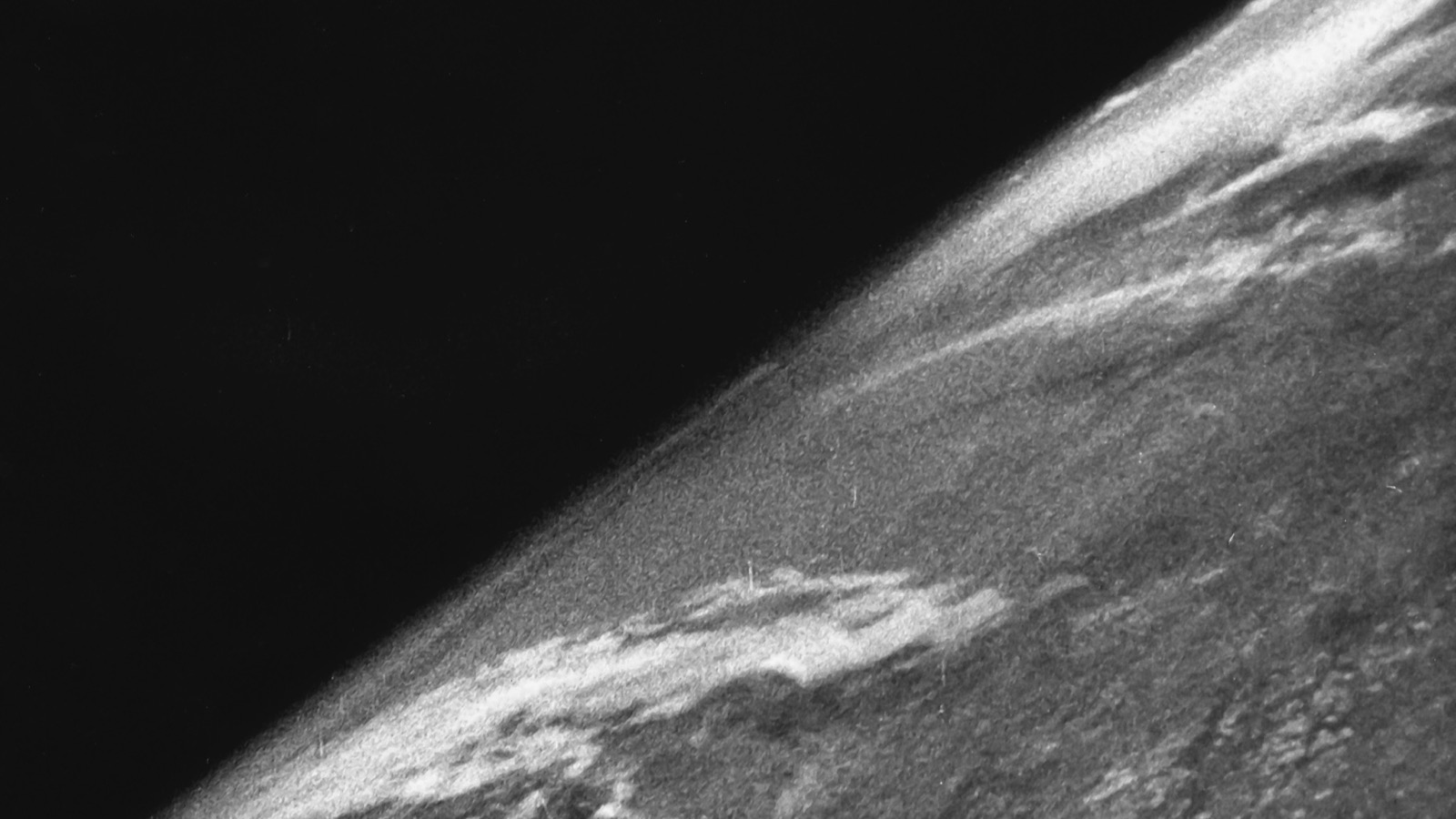
V-2 No. 13 carried a 35-millimeter motion-picture camera above New Mexico. It exposed one frame every 1.5 seconds as the rocket climbed. At about 65 miles, the camera was looking down from beyond the atmosphere’s generally recognized boundary. No earlier photograph had shown Earth from that height. The missile then struck the desert at more than 340 miles per hour. Its film came back intact.
One famous still came from a strip of film
The familiar black-and-white image is one frame from a motion-picture sequence. That is why official accounts describe the achievement both as the first image of Earth from space and as the first films or photographs made there.
NASA describes the rocket’s peak altitude as about 65 miles, or 105 kilometers, just above the generally recognized boundary of outer space. The Smithsonian’s National Air and Space Museum says the imagery covered roughly 40,000 square miles.
The flight was suborbital. V-2 No. 13 rose above the atmosphere’s conventional boundary and fell back without circling Earth.
The first photograph from orbit came later. In August 1959, Explorer 6 transmitted a crude view of Earth from about 17,000 miles away. The V-2 film preceded that orbital image by nearly 13 years.
The camera rode on a weapon built with forced labor
The V-2 was the world’s first modern long-range ballistic missile. Late in World War II, Germany launched almost 3,000 of the rockets against England, France and Belgium, according to the Smithsonian.
The Smithsonian records that concentration-camp prisoners were forced to manufacture V-2s at the underground Mittelwerk plant.
After the war, the United States moved captured rocket hardware to New Mexico. White Sands Missile Range says 300 rail cars filled with German V-2 components arrived at what was then White Sands Proving Ground in August 1945.
Engineers reconstructed the missiles for flight tests and upper-atmosphere research. One of those rebuilt rockets carried the camera on Oct. 24, 1946.
The film kept the view
The surviving frame is rough by the standards of later space photography. Earth’s dark horizon curves beneath black space, with cloud patterns spread across the surface. It is not a full-disk portrait like the images that followed from satellites and lunar missions.
Its altitude made it new. No earlier camera had photographed Earth from space, and the film brought that view back despite the rocket’s high-speed impact.
The photograph itself cannot show the history of the machine beneath the camera. The launch record supplies what the frame leaves outside its borders: the first camera to look back from space reached that height on a weapon designed for cities and produced through forced labor.
Sources and supporting documents
Rowan Price is a named OMG editorial voice, not a fictional human biography. This story passed separate evidence, rights, line-editing, originality, and skeptical-review checks before publication.
NASA20 Years Ago: First Image of Earth from Mars and Other Postcards of HomeNASA Johnson Space Center Gateway to Astronaut Photography of EarthEarth Observations TimelineNASA75 Years Ago: First Launch of a Two-Stage RocketU.S. Army White Sands Missile RangeAbout White Sands Missile RangeSmithsonian National Air and Space MuseumV-2 Missile, object A19600342000Wikimedia CommonsFirst photo from space