The fossil record that refuses to stay visible
Some White Sands fossil tracks fade from view until moisture reveals them again
The impressions cannot be lifted safely, so researchers use careful handwork, magnetic measurements and 3D photography to read them in place.
The tracks do not move. The ground around them changes. At White Sands National Park, some fossil footprints sit beneath a surface crust for part of the year, physically present but nearly invisible. When local moisture rises, the material inside a print can stand out more clearly from the surrounding sediment.
A footprint can return without changing
These depressed impressions are sometimes called ghost tracks. They do not reform or rise through the ground. Only the contrast changes, giving the eye an outline it could not follow before.
The National Park Service says changing moisture may also build salt around the edges as a track appears to disappear and reappear. That makes the field record unusually temperamental. A fossil can remain intact while the surface gives almost nothing away.
Today’s poster begins with a vanished lake
White Sands is the subject of the official artwork for the 17th National Fossil Day on October 14. The illustration gathers Ice Age animals around a wetland, with four track shapes set in its corners.
The water is not artistic license. The dry playa and salt flat seen today were once part of a system of wetlands and lake margins. NPS researchers have identified more than 20 sedimentary horizons through more than 10 vertical feet of deposits. Those layers hold thousands of trace fossils, including prints left by humans, giant ground sloths, horses, large cats and short-faced bears.
A trace fossil is not part of the animal. It is the change the animal left behind, which makes the ground itself part of the evidence.
Nothing this fragile can leave the ground
The tracks survive in soft gypsum and carbonate sediment. They are too fragile to remove safely, so the tools and cameras have to come to them.
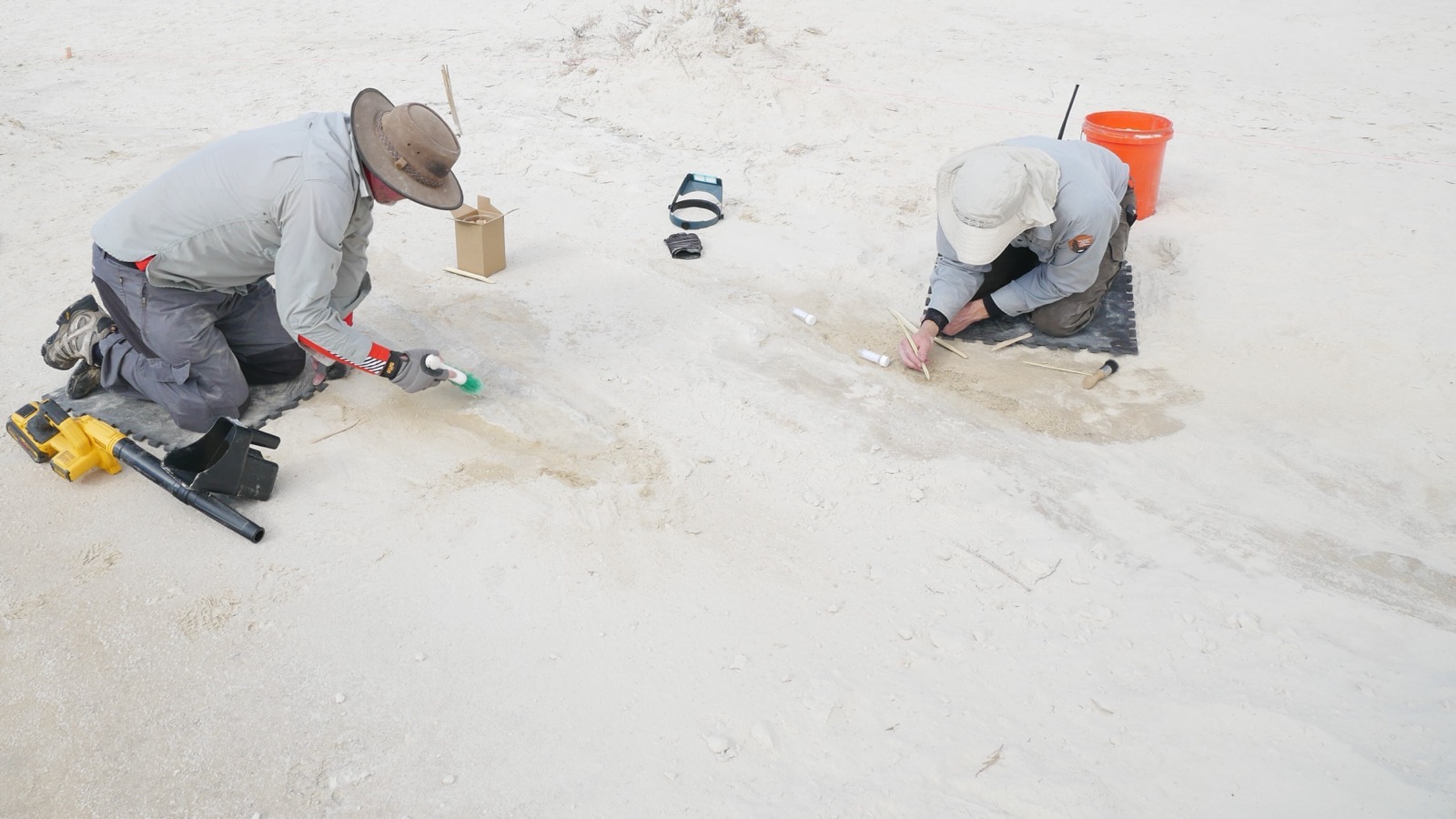
In the National Park Service photograph used with this story, two researchers work close to the surface with a brush and a small scraper. The image does not identify a particular print as human or assign it an age. It shows the care required to clear loose material and sharpen a fossil outline without treating the site like an ordinary excavation.
Non-destructive instruments can widen that view. Magnetometry detects tiny differences in magnetic fields. Photogrammetry combines overlapping photographs into a three-dimensional model. The methods help researchers find, measure and document tracks that may be difficult to see, but the original evidence remains in place.
The public gets a cast because the original cannot travel
The park says the fossil footprints themselves are currently inaccessible to visitors. Its visitor-center exhibit uses casts, and White Sands scheduled a free National Fossil Day drop-in program from 10 a.m. to 2 p.m. local time today with rarely exhibited casts, molds and collection objects.
A cast can preserve a shape and cross the visitor-center courtyard. The original is more delicate: an impression held in sediment at the place where a foot once pressed into wet ground. It stays there, even when the surface stops showing it.
Sources and supporting documents
Rowan Price is a named OMG editorial voice, not a fictional human biography. This story passed separate evidence, rights, line-editing, originality, and skeptical-review checks before publication.
National Park ServiceNational Fossil Day 2026National Park ServiceFossils of the 2026 National Fossil Day ArtworkWhite Sands National Park, National Park ServiceFossilized FootprintsNational Park ServiceNational Fossil Day Drop-in ProgramNational Park Service NPGalleryArcheologists Uncover Ice Age Footprints