The oxygen ledger
Thirty-seven dwarf galaxies kept no more than a quarter of the oxygen their stars made
Hubble resolved the stars that recorded each galaxy's history. Gas, dust, stars and stellar remnants supplied the inventory, while the diffuse space around them remained only partly counted.
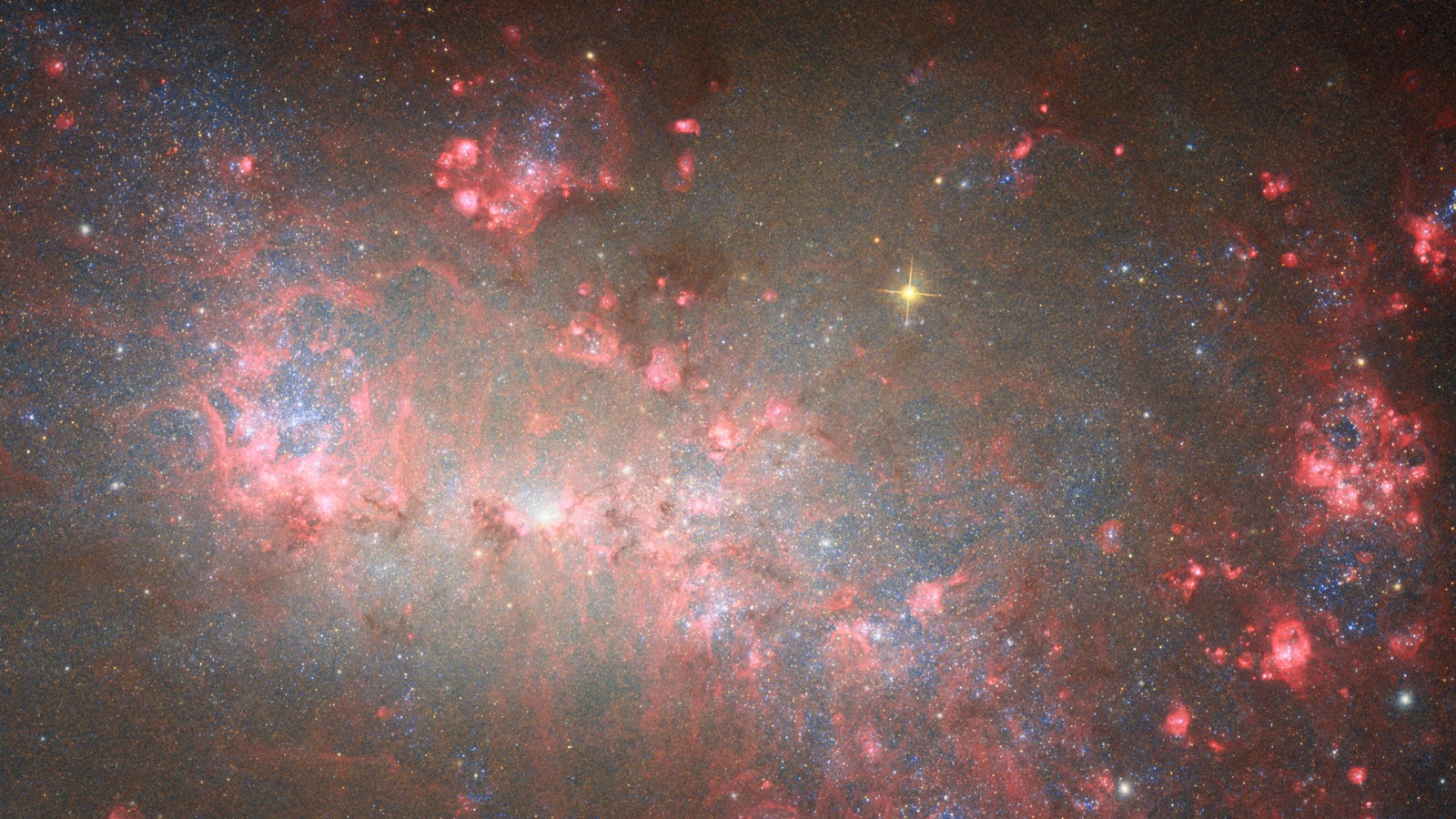
NGC 4449 looks unruly in its Hubble portrait. Blue stars crowd the frame. Pink star-forming regions shine through lanes of dark dust, with no spiral arms to impose order. The image shows one member of the Galaxies Losing Oxygen via Winds project, or GLOW. Researchers used resolved stars in 37 nearby, low-mass, gas-rich galaxies to reconstruct their histories and estimate how much oxygen those stars had produced. Then they counted what remained in each galaxy's disk. The retained share ranged from 4% to 25%. The mean was 10.7%.
The census began with stars, not escaping gas
High-mass stars forge oxygen and release it through stellar winds and supernova explosions. Because oxygen is abundant and comparatively practical to measure, astronomers can use it to follow how chemically enriched material moves through a galaxy.
GLOW did not photograph oxygen leaving. The team built a budget.
Archival Hubble observations allowed researchers to resolve stellar populations and reconstruct each galaxy's history of star formation. An adopted stellar yield turned that history into an estimate of how much oxygen the stars had produced.
The team compared that production estimate with oxygen still accounted for in gas, dust, stars and stellar remnants. The analysis also used observations from NASA's retired Spitzer Space Telescope, the Very Large Array and the Australian Telescope Compact Array.
The result is an evidence-based reconstruction, not a count of individual oxygen atoms. It depends in part on assumptions about stellar production and the measurements used for each reservoir.
Most of what remained was in the gas
None of the 37 galaxies retained more than 25% of its estimated oxygen production inside the disk. Nearly all the oxygen that remained was in gas. Stars, stellar remnants and dust held much smaller shares.
Astronomers already expected dwarf galaxies to lose substantial amounts of chemically enriched material. Their gravitational wells are shallower than those of giant galaxies, and energy from high-mass stars and supernovae can drive gas outward.
The measured deficit was still larger than several hydrodynamical simulations predicted. Some of those models reproduce the broad relationship between a galaxy's mass and chemical abundance while retaining much more oxygen than the GLOW galaxies did.
The sample also contained a tentative environmental pattern. Galaxies more than about 1 megaparsec from a higher-mass neighbor all retained less than 15% of their oxygen. Galaxies closer to higher-mass neighbors showed a wider spread toward higher retention.
That does not establish that neighboring galaxies caused the difference. The sample is small and spans a limited range of environments. The authors present recycling, environmental pressure and later accretion as possibilities, not a settled mechanism.
The rest has no confirmed address
“Missing” is an accounting term here. It means oxygen estimated to have been produced but not found in the measured disk reservoirs.
Previous studies have detected highly ionized oxygen in the circumgalactic medium, the diffuse region beyond a galaxy's bright body. The paper says those observations account for roughly 1% to 7% of the expected oxygen. Corrections for oxygen in other ionization states could raise the circumgalactic estimate to between 5% and 35%, but those corrections remain uncertain.
Some of the missing oxygen may therefore linger around the galaxies. Some may have escaped farther into intergalactic space. The current census cannot divide the missing share between those destinations.
The Hubble portrait carries the same limit. NGC 4449 is one of the galaxies in the study, but its bright stars and glowing gas do not reveal oxygen leaving or show where that material went.
On average, the researchers could account for 10.7% inside the galaxy disks. The next part of the search begins where the portrait ends.
Sources and supporting documents
Rowan Price is a named OMG editorial voice, not a fictional human biography. This story passed separate evidence, rights, line-editing, originality, and skeptical-review checks before publication.
The Astrophysical JournalGLOW. II. A Census of Oxygen in Low-mass GalaxiesarXivGLOW II: A Census of Oxygen in Low-Mass GalaxiesNASANASA’s Hubble Uncovers Case of Missing Oxygen in Nearby Dwarf GalaxiesESA/HubbleSmall but mightyESA/HubbleUsage of images, videos and web texts